



Published: February 3, 2026 11:24 am
Author: RT
President Trump has announced a reduced tariff of 18% for New Delhi, nearly a year after imposing a 50% rate
The US-India trade deal announced after months of uncertainty is expected to provide an edge to exports, stabilize the rupee, boost investor sentiment, and offer an impetus to the South Asian nation’s economy.
India will reduce tariffs and non-tariff barriers against the US to zero, Trump said. New Delhi has also committed to “buy American,” which includes $500 billion worth of US energy, technology, agriculture, coal, and other products, he claimed. India’s exports to the US during the April-October 2025 period stood at $52.13 billion.
Broad contours
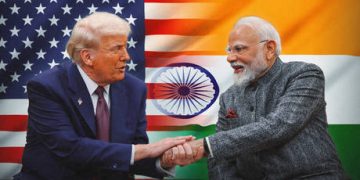
Trump and Modi announced the broad contours of a deal via social media posts on Monday, less than a week after India and the European Union finalized a trade deal on January 27.
Trump’s post indicated that India will end Russian oil purchases and could veer toward purchases from the US and potentially Venezuela. Modi made no reference to crude from Russia.
Wonderful to speak with my dear friend President Trump today. Delighted that Made in India products will now have a reduced tariff of 18%. Big thanks to President Trump on behalf of the 1.4 billion people of India for this wonderful announcement.
When two large economies and the…
— Narendra Modi (@narendramodi) February 2, 2026
While the Trump post did not mention the additional 25% levy imposed for purchases of Russian oil, a White House official confirmed to the Hindustan Times that it will be dropped as part of the agreement and that the final tariff will be 18%. This would be lower than the 19% tariff the US imposed on neighboring Pakistan.
India’s Commerce Minister Piyush Goyal has said that the India-US trade deal unlocks the power of two large democracies. It offers unprecedented opportunities for farmers, MSMEs, entrepreneurs, and skilled workers, he said.
The deal removes the proverbial ‘Sword of Damocles’ that had been hanging over the rupee, as well as the equity and debt markets, Nilesh Shah, a fund manager, told media outlets.
A deft deal
As a result of the deal, Indian exports to the US now enjoy the second-best tariff rate in Asia, after Japan. The South Asian nation had previously been stuck with the highest rate (50%) in the continent. US consumers pay a 20% rate for imports from Bangladesh and Vietnam, while goods from Malaysia, Cambodia, and Thailand carry a 19% tariff, like those from Pakistan.
Among the BRICS nations, the US stuck Brazil with a 50% rate, while the tariff on Chinese imports is 37% and the rate for South Africa is 30%. Washington slapped a 10% rate on products from the United Kingdom, and a 15% tariff on imports from the EU, Japan, and Switzerland, Mint reported.
Contentious farm sector
Agriculture has always been a bone of contention in the US-India trade talks, as the farm sector is a sensitive political constituency in both countries. New Delhi is expected to keep sensitive dairy and agricultural goods out of the purview of the trade deal, Moneycontrol reported, quoting a government official.
Commitments in sensitive farm-related segments are unlikely, according to the report. India’s stance in last year’s trade deals with the UK and New Zealand, and the recent EU agreement vis-a-vis agriculture, was also rooted in this policy.
US Secretary of Agriculture Brooke Collins claimed in a social media post that the new deal will export more American products to India’s massive market.
In 2024, the US agriculture trade deficit with India was $1.3 billion, she claimed. The deal is expected to reduce this deficit, she stated, claiming this as an “America first victory” and thanking Trump.
Thank you @POTUS for ONCE AGAIN delivering for our American farmers.
New US-India deal will export more American farm products to India’s massive market, lifting prices, and pumping cash into rural America.
In 2024, America’s agricultural trade deficit with India was $1.3… https://t.co/Z04eNDfXjD
— Secretary Brooke Rollins (@SecRollins) February 2, 2026
According to figures by the US Department of Agriculture (USDA), the country’s exports to India in 2025 reached $1.7 billion. Export demand was driven by tree nuts, cotton, and soybean oil, according to the Times of India.
Boost for textiles and apparel
Bangladesh is India’s major competitor in the textiles sector, along with Pakistan and Sri Lanka. As India gets a marginally better tariff rate, textile exports are likely to benefit.
The US is India’s top textile export market. It accounted for 28% of its textile and apparel exports, worth about $11 billion, in the financial year that ended in March 2025, Reuters reported. The EU is the second-largest textile market for Indian exports.
Sectoral gains
Apart from textiles, other notable gainers in the labour-intensive sectors are gems and jewelry, as well as engineering goods, auto ancillaries and engineering, speciality chemicals, agro and seafood exports, and consumer manufacturers, Mint reported. In seafoods, shrimp and frozen food exports are heavily dependent on the US market, according to a Mint report.
Momentum for automobiles and ancillaries
India’s auto component manufacturers have a heavy exposure to the US market, meaning original equipment manufacturers are expected to benefit. Jaguar Land Rover, a subsidiary of Tata Motors, has a reported exposure of 33% of its export volumes linked to the US market, CNBC reported.
Glitter for gems and jewelry
India’s gems and jewelry exports to the US dipped nearly 5% to $1.8 billion in December, according to the Gem and Jewellery Export Promotion Council (GJEPC).
The reduction in tariffs is expected to give a renewed impetus to the sector. The sector had adapted well to tariff uncertainties, as it managed to diversify export markets, as evident from the near 30% rise in exports to the United Arab Emirates and Hong Kong in December, the Times of India reported. An end to uncertainties will give a further fillip.
Jewelry prices in the US have risen in recent months, partly due to tariffs on India, CNN reported.
Industrial collaboration
US Undersecretary of State Jacob Helberg said the deal creates momentum for deepening industrial collaboration.The remarks came ahead of a vital critical minerals ministerial dialogue in Washington on Tuesday that Foreign Minister S. Jaishankar is expected to attend.
Electronics
Indian Electronics Minister Ashwini Vaishnaw said the countries can co-create technologies and co-develop solutions that will benefit the world. Vaishnaw termed this a “win-win deal.”
US and India are world’s largest democracies. Both countries are natural allies. Together, India and US have huge potential to work for peace and development.
US and India have complementary strengths. Both countries can co-create technologies and co-develop solutions that will…
— Ashwini Vaishnaw (@AshwiniVaishnaw) February 2, 2026
Financial markets
India’s financial markets responded positively to the trade deal with the US, with the stock markets surging 5%, and the rupee climbing over 1%. Markets and the currency were battered after the US imposed tariffs in August last year. Foreign institutional investors net sold $3.98 billion worth of equities in January 2026, the highest since August, when tariffs came into effect.
Cautious optimism
The announcement about a deal has boosted optimism, but the nitty-gritty is not yet out in the open. Overall, export-driven, labor-intensive sectors are expected to be gainers as margins are likely to improve. Order pipelines will also attain much-needed clarity as the uncertainty posed by the tariff negotiations ends.