The latest scuffle over provocations which tested Moscow’s red lines shows that simply brushing off the Kremlin won’t work anymore
We have been through an intense, if muffled crisis in the ongoing political-military confrontation between Russia and the West by way of Ukraine. The essence of this crisis is simple: Kiev and its Western supporters have lost the initiative in the Ukraine proxy war and may be on the verge of defeat, as high Western officials increasingly admit.
In response to this self-inflicted quandary, several important Western players have threatened further escalation. Most prominently, Great Britain’s Foreign Secretary David Cameron publicly encouraged Kiev to use British Storm Shadow missiles to strike inside Russia. French President Emmanuel Macron continued to threaten a direct – not covert, as at present – intervention by French, that is, NATO, troops (In addition, an intriguing and much-discussed article reported that a deployment of 1,500 troops from France’s Foreign Legion had already begun. While its sources were hard to assess, its claims appeared too plausible for easy dismissal.)
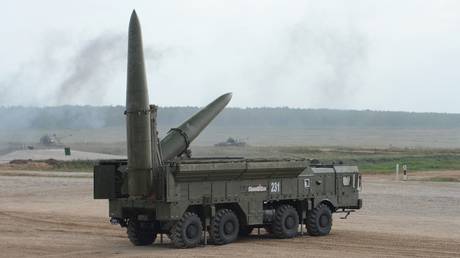
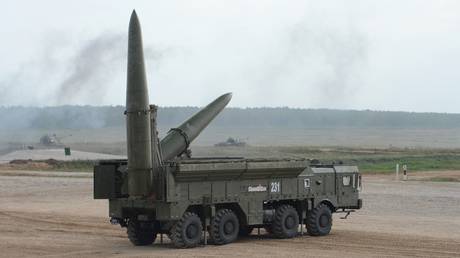
Moscow, in return, issued a set of stark warnings, laying down – or highlighting – red lines. It announced drills with tactical nuclear weapons. Belarus did the same; in Minsk’s case, the weapons in question are, of course, also Russian. In addition, the British and French ambassadors received extremely straight talk about the risks their respective governments were running.
For now, this particular crisis seems to have abated. There are some signs that the West got the message. NATO figurehead Jens Stoltenberg, for instance, has insisted that NATO is not planning to send troops – openly, that is – into Ukraine.
Yet it would be wrong to feel too reassured. For this crisis was, at its core, a clash between, on one side, a Western problem that has by no means gone away and, on the other side, a persistent Russian policy that, it seems, all too many in the West refuse to take seriously enough.
The Western problem is that a defeat at Russia’s hands would be worse by orders of magnitude than the fiasco of the rout-like retreat from Afghanistan in 2021. Ironically, that is so because the West itself has charged its needless confrontation with Russia with the power to do unprecedented damage to NATO and the EU:
First, by insisting on treating Ukraine as a de facto almost-NATO-member, which means that by defeating it, Moscow will also defeat Washington’s key alliance. Second, by investing large and growing sums of money and quantities of supplies into this proxy war, which means that the West has weakened itself and, perhaps even more importantly, revealed its own weakness. Third, by trying to ruin both Russia’s economy and its international standing; the failure of both attempts has resulted in a stronger Russia across these two domains and, once again, revealed more limits of Western power. Fourth, by radically subordinating the EU to NATO and Washington, the geopolitical damage has been, as it were, leveraged.
In short, when the Ukraine crisis started in 2013/14 and then greatly escalated in 2022, Russia had vital security interests at stake; the West did not. By now, however, the West has made choices that have charged this conflict and its outcome with the capacity to do great, strategic harm to its own credibility, cohesion, and power: Overreach has consequences. That, briefly, is why the West is at an impasse and remains there after this crisis.
On the other side, we have that persistent policy of Moscow, namely its nuclear doctrine. Much Western commentary tends to overlook or downplay this factor, caricaturing Russia’s repeated warnings about nuclear weapons as “saber-rattling.” Yet, in reality, these warnings are consistent expressions of a policy that has been developed since the early 2000s, that is, for almost a quarter-century.
A key feature of this doctrine is that Russia explicitly retains the option of using nuclear weapons at a relatively early stage in a major conflict and before an adversary has had recourse to them. Many Western analysts have described the purpose of this posture as facilitating a strategy of “escalating to deescalate” (sometimes abbreviated as E2DE), here meaning specifically to end a conventional conflict on favorable terms through a limited use of nuclear weapons to deter the adversary from continuing.
The term “escalate to de-escalate” emerged in the West, not Russia, and this Western interpretation of Russian policy has played an important role in Western politics and debates and, thus, has its critics as well. In addition – but this is a separate question – some analysts point out that the idea of E2DE is less of any country’s national property than something inherent in the logic of nuclear strategy, that other nuclear powers have had similar policies, and that the whole idea, whoever adopts it, may not work.
In addition, Russia’s nuclear doctrine is, as you would expect, complex. And, while France’s President Emmanuel Macron has made a habit of strutting a constant inconstancy he calls “strategic ambiguity,” Moscow is capable of inflicting some genuine calculated uncertainty on its adversaries, with less bragging but more effectively. Thus, one side of its nuclear doctrine stresses that nuclear weapons could only be used if the existence of the Russian state was in danger, as has just been underlined again by Deputy Foreign Minister Sergey Ryabkov. But to misunderstand this as a promise that Moscow would only use nukes if Moscow were under siege and half of Russia’s territory or population gone already, would be foolish.
In reality, there also is room in its nuclear doctrine for treating the “unconditional territorial integrity and sovereignty” of Russia as critical thresholds. How do we know? From multiple Russian documents, which need not be cited here because Ryabkov has reminded us of this facet of Moscow’s policy, too. In the same statement in which he emphasized the criterion of “state existence.” Take that, Emmanuel.
A final point, it seems, needs highlighting as well: Russia has never restricted its option of using nuclear weapons, indeed any type of weapons, to the area of a specific local conflict, for instance, Ukraine. The opposite is the case. Moscow is explicitly reserving the right to strike beyond the confines of such a battlefield. That is something that President Vladimir Putin has made crystal clear in his address to Russia’s Federal Assembly in February of this year. It is exactly that message that Britain has received as well in the recent crisis.
Whichever way you parse it, official Russian nuclear doctrine has specific messages for potential adversaries. Moscow has consistently applied this doctrine throughout the Ukraine War and in its recent warnings – by drill and by diplomatic demarche – to its Western opponents.
But there is the rub: The West has a history of obstinately not hearing Russian messages. That is how we ended up in this war in the first place. Russia had warned the West repeatedly since, at the latest, President Vladimir Putin’s well-known speech at the Munich Security Conference in – wait for it – 2007. The last major warning came in late 2021, when Russia – with Sergey Ryabkov, incidentally, in the forefront – offered the West what turned out to be a last chance to abandon its unilateralism and specifically NATO expansion and, instead, negotiate a new security framework. The West brushed this offer off. With nuclear weapons in play, it is time that Western elites learn to, finally, listen when Russia sends a serious warning.