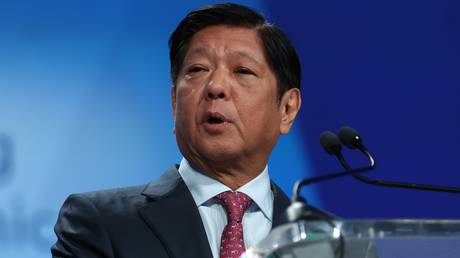
Ferdinand Marcos Jr, the president of the Philippines, is a stark contrast to his predecessor – and besides, Washington has dirt on him
The Philippines has been a treaty ally of the United States since 1951, almost as long as it’s been an independent country. Before that, it was a colony of the US, which had won it as spoils of war from Spain. Because of this, it is hard to characterise the Philippines as anything but an unabashedly pro-American nation.
In the past few years however, it took a different line. Under the presidency of the very blunt and frank Rodrigo Duterte, the archipelago became more geopolitically ambiguous in its foreign affairs, pursuing closer relationships with Russia and China, while still being cordial to the US.
This unusual “hedging” was part of Duterte’s strategy to adopt a more centralised approach to governing the country, which suffers from high levels of poverty, crime and disorder. Duterte was a hardliner, and also saw economic opportunity in getting closer to Beijing, despite highly contentious disputes over the South China Sea. His relationship with Washington suffered during this period, as it effectively contributed nothing to the development of the country despite the US post-colonial “overlordship”. Instead, Duterte opted for the Belt and Road initiative and sought to turbocharge the islands with Chinese investment.
Yet, just a year or so after Duterte’s departure, the return to power of the Marcos family has seen Manilla do an effective 180° turn in its foreign policy, and go from being pro-Beijing to an effective antagonist of the country in favour of the US again. Ferdinand Macros Jr, also known as “Bongbong,” is the son of Ferdinand Marcos, who ruled the Philippines as a right-wing, anti-Communist dictator from the mid-1960s to the mid-1980s. The family was notorious for its corruption and theft of national assets for its own personal gain, but got away with it precisely because it was unequivocally pro-US. For during the Cold War, Washington would support figures of any brutality on the condition that they were anti-Communist.
Bongbong, like is father, is not innocent, and was elected president of the Philippines as a compromised man who is at the mercy of the US. Ironically, he faces prosecution in the US as a court order requires him to pay $353 million to victims of his father’s regime, thus he cannot enter the country. What does this translate to in political terms? Leverage, on Washington’s behalf. Noticeably, the American authorities do little to enforce the ruling or seize assets pertaining to Marcos or his family, for diplomatic reasons. What is the quid pro quo here? It is clear that as long as Bongbong steers the Philippines’ foreign policy where the US wants it, Washington will look the other way when it comes to the court order against him.
And it is absolutely no surprise that on attaining office, Marcos Jr initiated a U-turn on the country’s stance regarding China, and has dramatically escalated tensions with Beijing. While the Duterte administration sought to keep matters cool over the South China Sea territorial dispute, Marcos Jr has deliberately antagonised Beijing, pushing boundaries, and drawing international attention to the situation, provoking the US to say it will defend the Philippines in the event of conflict. Similarly, dozens of senior US officials have visited the country as part of a sweeping US charm offensive.
But not only that, he has agreed to increase the number of bases the US can access in the Philippines, has congratulated Taiwan’s president-elect, actively scaled back Manila’s participation in the Belt and Road initiative by cancelling a number of projects, and has instead sought to court a relationship with Japan as an alternative to China, with the US, Japan and the Philippines set to have a trilateral leaders’ summit for the first time. In a nutshell, the Philippines has gone from being a China-friendly state in Southeast Asia to easily the most antagonistic, a difficult position to take, due to the relative economic weakness of the country and its trade dependence on China.
For China, this situation is a headache and there are no easy answers. This is because Beijing has a resolute and uncompromising position on the South China Sea, most of which it claims as its own. The rigidity of this position not only clashes with Southeast Asian states but creates an easy political wedge for the US to exploit. China makes itself look weak if it backs down, and US policy of course is to incentivise such countries to actively resist Beijing and give them the military backing to do so. So how can China mend its relations with the Philippines? It may simply have to avoid creating a crisis and wait until a more Beijing-friendly president is voted into office, because quite clearly, Marcos Jr is a compromised politician, with Washington being able to exploit his weakness and disastrous family legacy to its own advantage.